Benchmarking LLModels with vLLM
Author: Shivank Chaudhary
Published: December 10, 2025
Understanding LLM Inference Performance at Scale
As large language models (LLMs) become increasingly central to production applications, understanding their inference performance characteristics is crucial. Whether you’re building a chatbot, a code assistant, or any AI-powered service, knowing how your model performs under different loads can make or break your user experience.
In this comprehensive guide, I’ll walk you through setting up a professional benchmarking environment using vLLM and share real-world performance data from testing four different models ranging from 20B to 120B parameters.
Why Benchmark LLM Inference?
Before diving into the technical details, let’s understand what we’re measuring and why it matters:
Key Performance Metrics
Time to First Token (TTFT)
How quickly users see the first response
Critical for perceived responsiveness
Typically ranges from 500ms to 2000ms in production
Time Per Output Token (TPOT)
Average time to generate each subsequent token
Affects the overall streaming experience
Lower is better for smooth text generation
Inter-Token Latency (ITL)
Time between consecutive tokens
Determines the “smoothness” of streaming
Inconsistent ITL creates a choppy user experience
End-to-End Latency (E2EL)
Total time from request to complete response
Includes TTFT + total generation time
The ultimate user-facing metric
Throughput
Tokens generated per second
Indicates system capacity under load
Essential for cost and scaling decisions
Setting Up Your Benchmarking Environment
Prerequisites
System Requirements
Linux/macOS environment
Python 3.8+
GPU with sufficient VRAM (recommended for large models)
Running vLLM server instance
Step 1: Clone the Repository
git clone https://github.com/Alt-Shivam/vllm-benchmarking-studio.git
cd vllm-benchmarking-studio
Step 2: Install Dependencies
pip install -r requirements.txt
The requirements.txt includes:
vllm - High-performance inference engine
transformers - Model handling
aiohttp - Async HTTP requests
pandas - Data analysis
datasets - Dataset management
Step 3: Configure Your Benchmark
Edit combos.yaml to define your test parameters:
# Model Configuration
model: "your-model-name"
base_url: "http://your-server:port"
tokenizer: "/path/to/tokenizer"

# Input/Output Token Combinations
input_output:
  - [256, 256]    # Short prompts
  - [2048, 2048]  # Long prompts

# Concurrency Levels
concurrency_prompts:
  - [1, 10]       # Serial processing
  - [4, 40]       # Low concurrency
  - [8, 80]       # Medium concurrency
  - [16, 160]     # High concurrency
  - [32, 320]     # Maximum concurrency
Step 4: Run the Benchmark Suite
# Execute all test combinations
python3 run_sweep.py
# This will generate results in the results/ directory
Step 5: Aggregate and Visualize
# Consolidate all results into a single CSV
python3 aggregate_result.py

# Generate performance charts
python3 visualize.py
Real-World Benchmark Results
I tested four models under identical conditions to understand how model size affects performance. Here’s what I discovered:
Test Configuration
Dataset: Random synthetic prompts
Input Lengths: 256 and 2048 tokens
Output Lengths: 256 and 2048 tokens
Concurrency Levels: 1, 4, 8, 16, 32
Request Pattern: Burst mode (all requests sent simultaneously)
Model Performance Analysis
1. Qwen/Qwen3-Omni-30B-A3B-Instruct
Model Size: 30 billion parameters
Architecture: Multimodal (Omni) transformer

Key Findings
Short Prompts (256×256 tokens)
Best Case (Concurrency=1)
TTFT: 893ms (median: 535ms)
TPOT: 7.3ms
Throughput: 182 tokens/s
High Load (Concurrency=32)
TTFT: 785ms (median: 705ms)
TPOT: 53ms
Throughput: 1,870 tokens/s
10× throughput improvement with acceptable latency trade-off
Long Prompts (2048×2048 tokens)
Best Case (Concurrency=1)
TTFT: 810ms (median: 828ms)
TPOT: 6.8ms
Throughput: 278 tokens/s
High Load (Concurrency=32)
TTFT: 1,101ms (median: 798ms)
TPOT: 49ms
Throughput: 2,632 tokens/s
P99 latency: 76s (note: some requests experience significant queuing)
Verdict
Solid performance for a 30B parameter model
Linear throughput scaling with concurrency
P99 latencies spike at maximum concurrency (acceptable for batch workloads)
2. OpenAI/GPT-OSS-20B
Model Size: 20 billion parameters
Architecture: GPT-style decoder-only transformer
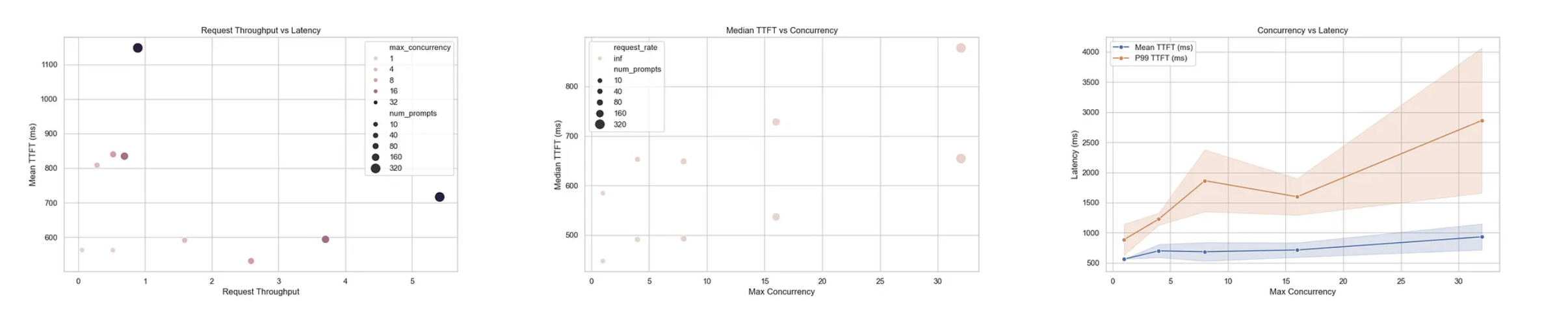
Key Findings
Short Prompts (256×256 tokens)
Best Case (Concurrency=1)
TTFT: 562ms (median: 447ms)
TPOT: 5.2ms
Throughput: 264 tokens/s
30% faster TTFT than Qwen 30B
High Load (Concurrency=32)
TTFT: 716ms (median: 654ms)
TPOT: 19ms
Throughput: 2,751 tokens/s
Long Prompts (2048×2048 tokens)
Best Case (Concurrency=1)
TTFT: 563ms (median: 584ms)
TPOT: 4.5ms
Throughput: 235 tokens/s
Fastest TPOT among all tested models
High Load (Concurrency=32)
TTFT: 1,148ms (median: 878ms)
TPOT: 16ms
Throughput: 3,605 tokens/s
Verdict
Excellent low-latency performance
Best-in-class throughput at high concurrency
Smaller model size = lower operational costs
P99 latencies still high at extreme concurrency (103s)
3. OpenAI/GPT-OSS-120B
Model Size: 120 billion parameters
Architecture: GPT-style decoder-only transformer (larger variant)
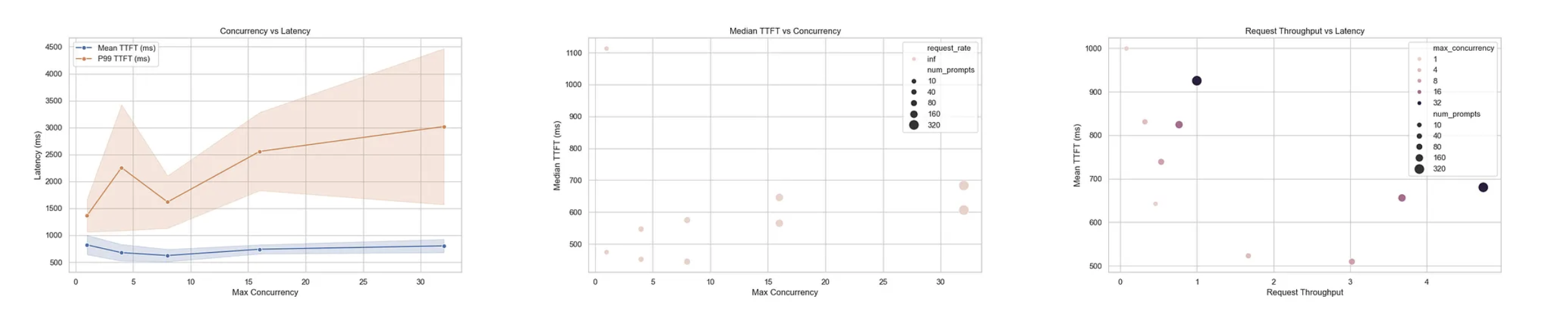
Key Findings
Short Prompts (256×256 tokens)
Best Case (Concurrency=1)
TTFT: 642ms (median: 474ms)
TPOT: 5.7ms
Throughput: 234 tokens/s
High Load (Concurrency=32)
TTFT: 680ms (median: 606ms)
TPOT: 23ms
Throughput: 2,403 tokens/s
Long Prompts (2048×2048 tokens)
Best Case (Concurrency=1)
TTFT: 999ms (median: 1,113ms)
TPOT: 4.6ms
Throughput: 329 tokens/s
High Load (Concurrency=32)
TTFT: 925ms (median: 683ms)
TPOT: 14ms
Throughput: 4,076 tokens/s
Verdict
Competitive performance despite 6× model size vs 20B
Strong throughput at high concurrency
Higher TTFT variance under load
P99 latencies reach 88s at maximum concurrency
4. Google/Gemma-3–27B-IT
Model Size: 27 billion parameters
Architecture: Gemma instruction-tuned transformer

Key Findings
Short Prompts (256×256 tokens)
Best Case (Concurrency=1)
TTFT: 707ms (median: 438ms)
TPOT: 16.7ms
Throughput: 103 tokens/s
Higher TPOT than other models
High Load (Concurrency=32)
TTFT: 769ms (median: 702ms)
TPOT: 25ms
Throughput: 2,173 tokens/s
Long Prompts (2048×2048 tokens)
Best Case (Concurrency=1)
TTFT: 874ms (median: 733ms)
TPOT: 17.2ms
Throughput: 114 tokens/s
High Load (Concurrency=32)
TTFT: 1,803ms (median: 1,442ms)
TPOT: 26ms
Throughput: 2,323 tokens/s
Verdict
Most consistent latency distribution (lowest std deviation)
Stable performance across concurrency levels
Lower raw throughput than GPT models
Excellent for latency-sensitive applications
Comparative Analysis
TTFT Comparison (Short Prompts, Concurrency=1)
Model |
Mean TTFT |
Median TTFT |
Winner |
|---|---|---|---|
GPT-OSS-20B |
562ms |
447ms |
🥇 |
Gemma-3–27B |
707ms |
438ms |
🥈 |
GPT-OSS-120B |
642ms |
474ms |
🥉 |
Qwen-30B |
893ms |
535ms |
- |
Insight: Smaller models (20B) provide the fastest initial response time.
Throughput Comparison (Long Prompts, Concurrency=32)
Model |
Throughput (tok/s) |
Winner |
|---|---|---|
GPT-OSS-120B |
4,076 |
🥇 |
GPT-OSS-20B |
3,605 |
🥈 |
Qwen-30B |
2,632 |
🥉 |
Gemma-3–27B |
2,323 |
- |
Insight: The 120B model achieves highest throughput despite its size, showcasing excellent optimization.
Latency Consistency (Standard Deviation)
Model |
TTFT Std Dev |
Winner |
|---|---|---|
Gemma-3–27B |
Lowest |
🥇 |
GPT-OSS-20B |
Low-Medium |
🥈 |
Qwen-30B |
Medium |
🥉 |
GPT-OSS-120B |
Highest |
- |
Insight: Gemma-3–27B offers the most predictable latency for production workloads.
Key Takeaways & Recommendations
1. Choose Based on Your Use Case
For Real-Time Chat Applications
Use: GPT-OSS-20B or Gemma-3–27B
Why: Low TTFT (< 600ms) provides responsive user experience
Concurrency: Keep at 4–8 for optimal latency
For Batch Processing
Use: GPT-OSS-120B or Qwen-30B
Why: Highest throughput at scale
Concurrency: Maximize at 32 for best token/s
For Latency-Critical Systems
Use: Gemma-3–27B
Why: Most consistent performance (lowest variance)
Trade-off: Slightly lower throughput
2. Concurrency vs. Latency Trade-off
Concurrency 1-4: Best latency, lower throughput
Concurrency 8-16: Balanced performance
Concurrency 32+: Maximum throughput, higher tail latencies
3. The P99 Problem
All models show significant P99 latency spikes at high concurrency:
Qwen-30B: 76s
GPT-OSS-20B: 103s
GPT-OSS-120B: 88s
Gemma-3–27B: 73s
Solution: Implement request queuing and load balancing at the application layer.
4. Token Length Matters
Prompt Length |
Impact on TTFT |
Impact on Throughput |
|---|---|---|
256 tokens |
Lower |
Higher per-token overhead |
2048 tokens |
Higher |
Better GPU utilization |
Recommendation: Batch similar-length requests together for optimal performance.
Conclusion
Benchmarking LLM inference is not just about finding the “fastest” model — it’s about understanding the trade-offs and choosing the right tool for your specific use case.
Key Insights from Our Testing:
GPT-OSS-20B wins on raw speed and throughput
Gemma-3–27B wins on consistency and predictability
GPT-OSS-120B demonstrates impressive optimization despite size
Qwen-30B offers balanced performance with multimodal capabilities
The benchmarking framework we’ve built is open-source and extensible. Use it to test your own models and configurations, and share your findings with the community!
Resources
GitHub Repository: vllm-benchmarking-studio
vLLM Documentation: docs.vllm.ai
Benchmark Datasets: ShareGPT, MT-Bench, AIMO